Why Scalp Health is the Foundation of Beautiful Hair
 By Anya Petrova
.webp)
Most people arrive at our therapy rooms thinking about their hair. Very few arrive thinking about their scalp. Yet almost every conversation about dullness, breakage, flatness, or slow growth eventually leads to the same place — the few centimetres of skin the hair is growing out of.
It is easy to forget that the scalp is skin. It has the same barrier, the same microbiome, the same capacity to become dehydrated or congested as the skin on your face. It simply has the highest density of oil glands anywhere on the body, and a dense forest of hair sitting on top of it, which makes it both harder to care for and easier to neglect.
The Scalp Is the Root of the Matter — Literally
Every strand of hair begins life inside a follicle embedded in the scalp. By the time hair emerges past the surface it is no longer living tissue; it cannot repair itself, and nothing applied to the mid-lengths will change how it was formed.
That is the practical case for scalp care. The condition of the follicle environment while a strand is being produced is the one variable you can still influence. Everything after that is damage limitation.
Recognising Congestion
Buildup is the most common issue we see, and it rarely announces itself dramatically. It accumulates from three directions at once: natural sebum, product residue from dry shampoo and styling creams, and ordinary environmental dust.
The signs tend to be subtle:
- Hair that goes limp at the root within a day of washing
- Tenderness or itching along the parting
- A faint film on the scalp that returns quickly after cleansing
- Styling products that suddenly seem to stop working
A note on flaking
Flaking is not automatically a sign of dryness. A dry scalp produces small, fine, powdery flakes and often feels tight. A congested or oily scalp can produce larger, waxier flakes that cling. The two conditions call for opposite treatments, which is why guessing at home so often makes things worse. If flaking is persistent, accompanied by redness, or spreading beyond the hairline, that is a conversation for a dermatologist rather than a salon.
Hydration Is Not the Same as Oil
An oily scalp can be dehydrated at the same time — a combination that surprises people. Excess oil is a barrier response; when the scalp senses it is losing water, oil production often increases to compensate. Stripping that oil with a harsh clarifying shampoo can accelerate the cycle rather than break it.
The better approach is gentler cleansing paired with genuine hydration: lightweight, water-based scalp serums with humectants rather than heavy oils, which mostly sit on top and add to the congestion.
Massage: The Least Glamorous, Most Effective Habit
Scalp massage is the single technique we recommend most, and it costs nothing.
Use the pads of your fingers — never nails — and work in small, firm circles, moving the scalp against the skull rather than sliding your fingers across the surface. That distinction matters; sliding creates friction on the hair, while moving the scalp itself is what produces the benefit.
Five minutes, three or four times a week, is a reasonable target. Many clients find it easiest to build into a dry evening routine while reading. The immediate effect is a pleasant release of tension across the forehead and temples; the longer-term effect is a scalp that simply feels less tight and less reactive.
In the Treatment Room
Professional scalp therapy adds three things that are difficult to reproduce at home.
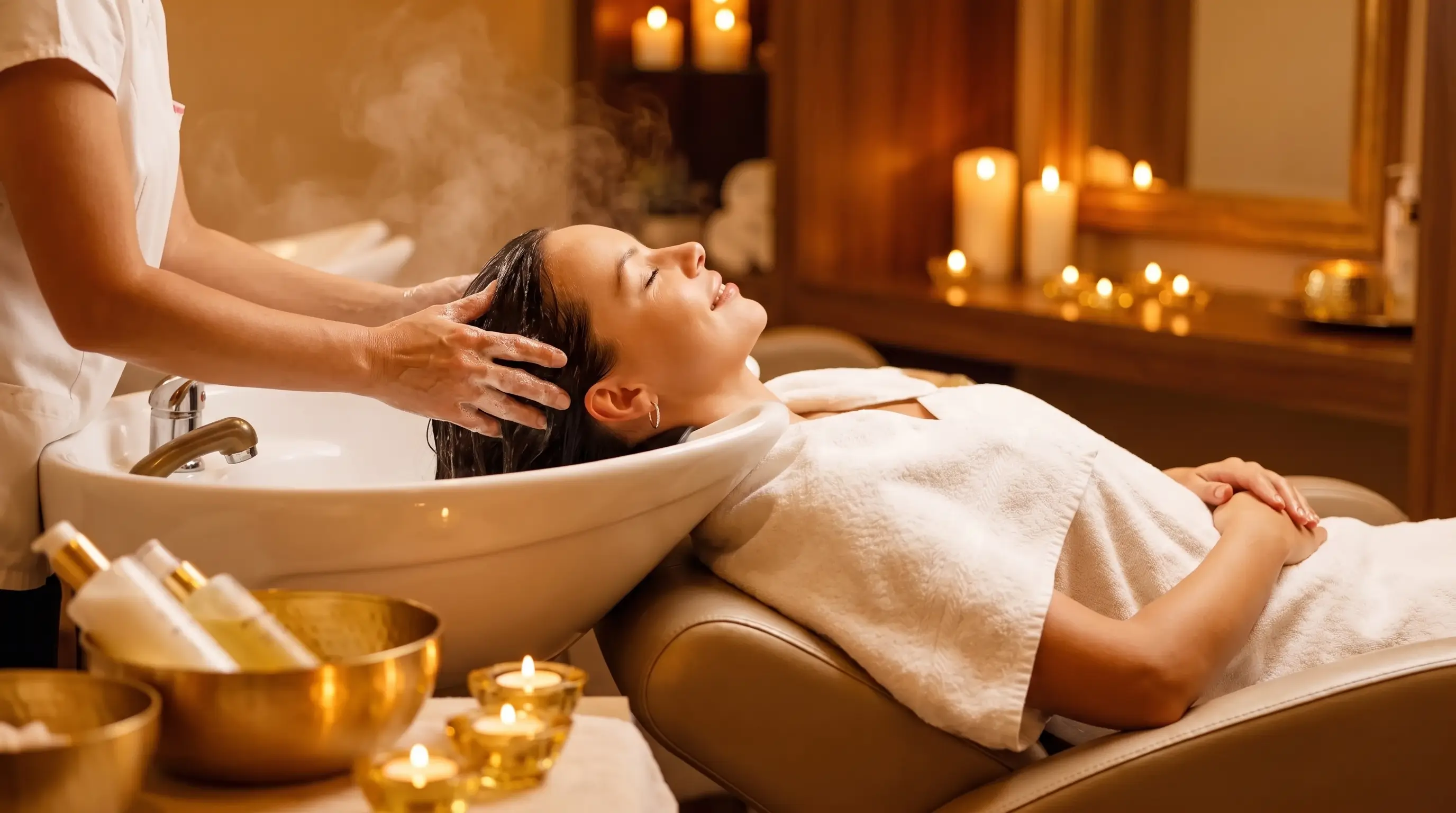
Steam activation
Gentle warmth and moisture soften sebum and product buildup, so it can be lifted away without aggressive scrubbing. Steam also makes the scalp considerably more receptive to whatever is applied afterwards.
Hydro-massage
Water delivered at controlled pressure and temperature cleanses the scalp thoroughly while providing sustained massage. It reaches the areas most people miss at home — the nape, behind the ears, and the crown — and it is, by some distance, the part of the treatment clients ask for again.
Rosemary-infused masks
Rosemary has a long history in traditional hair care and remains a favourite in our blends for its clean, invigorating aromatic profile and its pleasant tingle. We use it as part of a broader botanical formulation rather than as a standalone remedy, and we would encourage a healthy scepticism toward anyone promising dramatic regrowth from a single ingredient.
Habits That Support Healthy Growth
Scalp care sits inside a wider picture. The following are unglamorous and genuinely useful:
- Keep water temperature moderate. Very hot water strips the barrier quickly.
- Rinse thoroughly. Conditioner residue at the root is a frequent, invisible cause of buildup.
- Loosen tight hairstyles. Sustained tension at the follicle is a well-documented cause of thinning at the hairline.
- Protect from sun. The parting is skin, and it burns.
- Eat adequate protein and iron. Hair is one of the first things the body deprioritises when either runs low.
- Take sleep and stress seriously. Hair growth cycles respond to both, though usually on a delay of two to three months.
Give It Time
The most important thing to understand about scalp care is its timescale. Hair grows roughly a centimetre a month, and any improvement in follicle environment shows up only in the new growth. That means eight to twelve weeks before you see a difference, and longer before it reaches your mid-lengths.
This is why we build scalp therapy into a course rather than selling it as a single treatment. Consistency is doing almost all of the work; the treatment room simply accelerates it.
If your scalp feels tight, tender, congested, or simply unwell, that is worth addressing on its own terms — not as a means to better hair, but because comfortable skin is a reasonable thing to want. The hair tends to follow anyway.